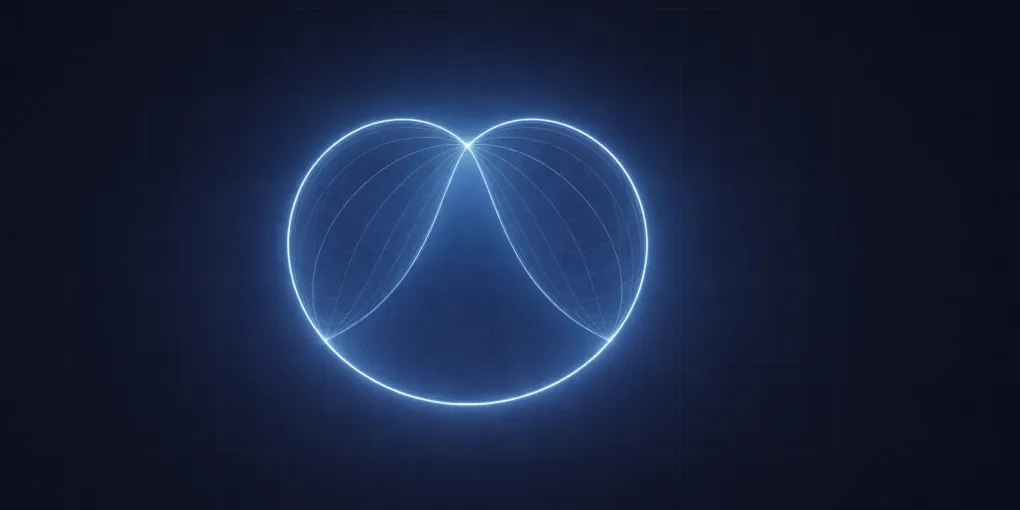
Caustics are the bright curves and patches that appear when reflected or refracted light is concentrated into a smaller area than the surface it came from. You have seen them as the shimmering web on a swimming-pool floor, the bright arc inside a coffee cup, or the cusp of light that a glass of water throws onto a table.
They are geometry made visible. A smooth mirror or a rippling water surface sorts a family of light rays, and where that family folds together the surface grows brighter. The surface writes its own shape into the light, so a caustic reads as a portrait of the reflector or the water rather than of the light itself.
This page builds the mental model behind those patterns, walks through three interactive demos, and points to the articles that work out the mathematics in full. You do not need any optics background to follow it, only the willingness to watch where a few rays go.
The One Idea Behind Every Caustic
The simplest model is to stop thinking of light as a smooth glow and start thinking of it as bundles of rays.
Emit many rays from the light and follow each one to the surface, then onward to wherever it lands. Where neighboring rays spread apart, the same light covers a larger area and the surface looks dim. Where they crowd together, the light piles up and the surface looks bright. The caustic is the boundary of that crowding: the curve that the rays graze as they fold past one another.
That boundary is the envelope of the ray family. The name sounds technical, but the intuition is plain: each ray touches the envelope once, the way a straight line is tangent to a curve, and together those touch points trace the bright line your eye sees. The mathematics of caustics turns that picture into equations: the envelope condition, the ray density that sets brightness, and the fold and cusp shapes a caustic can take.
Two rules decide how a ray turns at the surface:
- Reflection keeps the ray in the same medium and sends it away at the same angle it arrived.
- Refraction changes the ray’s direction when it crosses into a material with a different refractive index, following Snell’s law. The light refraction article covers that rule in detail.
Everything else is geometry. A flat surface turns every ray the same way, so an even bundle stays even and no caustic forms. Curvature makes the difference: on a curved surface, neighboring points face slightly different directions, so neighboring rays turn by different amounts and start to cross.
Reflection: Curved Mirrors and the Coffee Cup
A curved mirror is the cleanest place to watch a caustic form. Each point of the mirror reflects its ray according to the local surface normal, and because the normal turns from point to point, the reflected rays fan into a family that folds. The turn is one formula: an incoming unit direction reflects off a surface with unit normal into
The first demo makes that folding visible.
Drag the orange source dot and watch the purple crossing points: each one marks where two neighboring reflected rays meet, and together they outline the fold. At the gentlest curvature the reflected rays stay close to parallel and the fold drifts below the frame. A moderate setting gathers a narrow, pointed arc between the mirror and the source. Turn the curvature up and the tip climbs toward the mirror while the arc spreads across the canvas. Move the source sideways and the whole pattern leans the other way.
The coffee-cup arc is the same effect in a shape you can hold. Light reflecting off the circular inner wall gathers into one bright curve. In the demo, drag the point source around the cup and the arc slides and stretches in response.
The classical version of this problem, with parallel rays arriving from a distant source, produces a kidney-shaped curve called a nephroid. Real cups are not perfect circles, so what you actually see is a slightly distorted nephroid.
The mirror and the cup share one set of reflection rules. The reflection caustics article takes that shared machinery apart: it derives the vector reflection law, defines the envelope condition that turns crossing rays into an exact curve, works through the parabolic mirror used above, and shows how the ideal coffee-cup curve becomes a nephroid.
Refraction: Sunlight Through a Wavy Surface
Refraction caustics work the same way with a different turning rule. When sunlight enters water, each ray bends at the surface. If the water were flat and still, every ray would bend by the same amount and the pool floor would be lit evenly. A wavy surface breaks that uniformity: every slope tilts the local normal a little differently, so neighboring rays bend by slightly different angles and land at different depths. Where they bunch together the floor brightens, and where they spread it darkens. The bend obeys Snell’s law, where and are the refractive indices on the two sides and the angles are measured from the normal:
Raising the wave amplitude tilts the surface more steeply and deepens the contrast between bright and dark bands. Raising the wave frequency packs more crests across the pool and makes the bands finer and closer together. The sun angle slides the whole pattern sideways, and a higher water refractive index bends each ray harder and pulls the bright regions tighter. Because the surface keeps moving, the pattern keeps sliding and reorganizing, which is what makes a pool floor shimmer.
For worked examples of the bend, including the critical angle, apparent depth, and total internal reflection, see the light refraction article.
Reflection vs. Refraction at a Glance
The two families differ in one step, the direction update, and that difference shows up in what you see.
| Reflection caustics | Refraction caustics | |
|---|---|---|
| Turning rule | Equal angle across the normal | Snell’s law across the interface |
| What sets the normals | The shape of the mirror | The shape of the water surface |
| Typical example | Coffee cup, curved mirror | Swimming-pool floor, sunlight through glass |
| Main controls | Curvature and source position | Wave amplitude, frequency, and refractive index |
| Deep dive | Reflection caustics | Light refraction |
Where Caustics Show Up
Once you know the pattern, you start noticing it in odd places.
The clearest everyday example is moving water. Sunlight refracts through the ripples on a pool or shallow fountain, and the bright web on the bottom shifts with every change in the surface. A curved reflector produces the same effect in a smaller space: the inside wall of a coffee cup, the rim of a glass, or a polished spoon catches a nearby light and folds the reflections into a single bright arc or cusp.
Cut gemstones take the effect further. Their facets steer light into concentrated flashes that jewelers call fire and scintillation, which is part of what makes a well-cut stone look lively.
Computer graphics has its own reason to care. A renderer tracing ordinary camera rays has no cheap way to know where scattered light will land, so it simulates caustics with extra passes that collect and redistribute light. That work rests on the same habit these demos use: follow a ray, see where it goes, and watch where rays gather. The ray marching article explores how renderers build whole images from that habit.
Recap
Caustics appear when reflection or refraction squeezes a family of light rays into a smaller region than the surface it came from. The recipe is always the same: trace rays from the light, turn them at the surface using the local normal, and watch where they gather. A curved mirror steers neighbors toward each other, a circular cup sorts them onto one bright curve, and a wavy water surface bends sunlight into shifting bands. Keep the ray-density picture in mind, and the pattern becomes a map of the surface that made it.